Project overview
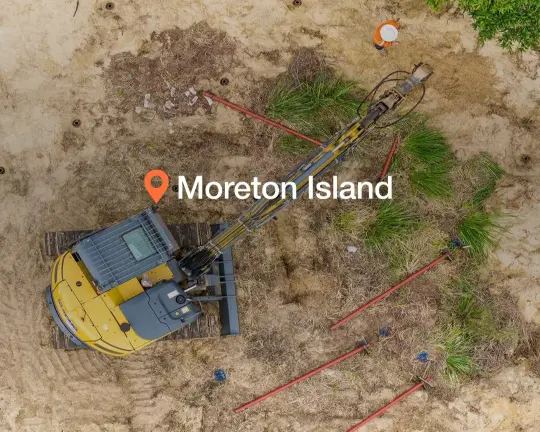
Blade Pile was engaged by KAYU Group to engineer, supply and install the screw pile foundations for three elevated homes on Moreton Island, a sand island 40km off Brisbane with no sealed roads and vehicle access by ferry only.
Our scope covered 150 Blade Piles across the three builds, installed beneath engineered strip footings and tied into each footing through an engineered pile-to-footing connection. The full program — mobilisation, 150 piles across three separate builds, and demobilisation — was completed in five days on site.
Challenge: everything comes by ferry
Moreton Island is 37km long, roughly 95% national park, and has no road connection to the mainland. The only vehicle ferry is the Micat, which runs from the Port of Brisbane to the beach at the Tangalooma Wrecks in around 90 minutes on a demand-based timetable. Once on the island, all movement is by 4WD on sand tracks and beaches.
For a piling contractor that meant:
- Mobilisation by ferry only. Piles, the excavator and drive head, the crew vehicle and accessories all had to be scheduled onto the Micat.
- A fixed timetable. The Micat runs to demand and can operate as little as once a day outside peak periods.
- Three builds, 150 piles. The crew was working to three sets of footings and three engineered layouts on one mobilisation.
- Concrete was the alternative. On a ferry-access site, a pour that gets rained out costs the builder ferry bookings as well as days.
Our implementation: engineered screw piles beneath strip footings
Blade Pile’s in-house engineering team designed the foundation system as strip footings on screw piles. The residential screw piles carry the structural load to depth; the strip footings tie the elevated structures together at the surface; and each pile is connected back into its footing through an engineered connection, so the two act as one system.
The piles specified for this project were 3.0m Blade Piles with 76×4mm shafts and 350×12mm twin blades in 450 grade steel, each engineered to a design load of 80kN. Founding depths across the three builds ranged from 3m to 7m, with 1m extensions used where the engineered depth exceeded a single pile length.
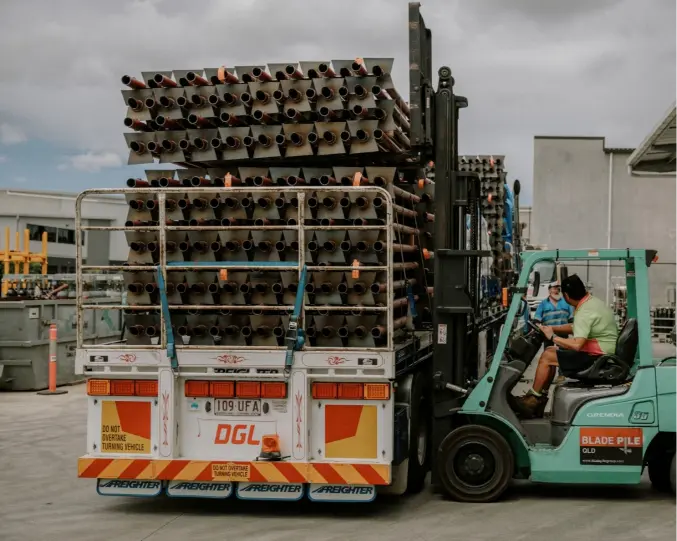
Piles were manufactured at our Yatala factory and shipped with the installation rig and crew on the Micat from the Port of Brisbane. On site, the entire program ran on one rig and a two-man crew — an operator and offsider — driving each Blade Pile to the engineered requirements with installation torque monitored throughout. Once depth was reached, the strip footings were excavated around the piles and the engineered connections made. Blade Pile’s Queensland BDM and site engineer travelled out to the island during the program to inspect the works.
Blade Pile installations are carried out in accordance with AS 2159, with installation records maintained as part of the project’s engineering documentation.
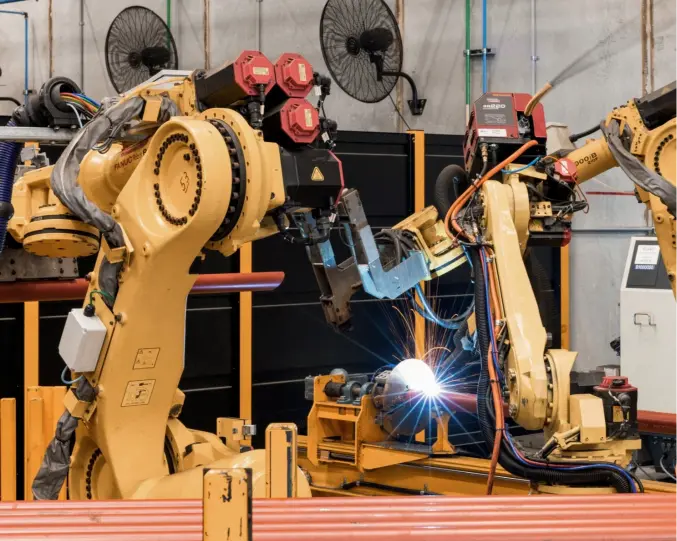
Manufactured in-house, cut by Laser Blade
Every Blade Pile on this project was manufactured at our Yatala factory, with the twin blades profiled by our laser cutting partner Laser Blade on the TRUMPF tube laser that shares our production floor. Cutting blades and shaft profiles under the same ISO 9001 system that governs pile design and installation means the geometry the engineer specifies is the geometry that goes in the ground.
I do trust the way they’re engineered. These prices don’t change. No dry time. Straightforward.
Chris Humphries — KAYU Group
Asked why he chose screw piles over concrete for Moreton Island, Chris gave three reasons: confidence in the engineering, price certainty once the piles and rig were across, and no curing period. Asked whether he would use Blade Pile again, his answer was that it was not a question of “would” but “will”, with larger projects already planned on the same system.
Project outcome: 150 piles, three homes, five days
- 150 Blade Piles engineered, supplied and installed across three elevated homes.
- Completed in five days on site (10–14 June 2026) with no delays despite ferry-only access — an average of 30 piles a day.
- One rig and a two-man crew carried the whole program, keeping the ferry mobilisation footprint to a minimum.
- Every pile installed to the engineered 80kN design load, with installation data recorded for certification.
- No concrete curing period at the installation stage; the piles are designed to be immediately load-bearing.
- Client planning further, larger projects on the same system.
A foundation system for sites the mainland rules don’t reach
Remote and elevated residential builds put pressure on the same two things: getting everything to site, and keeping the program moving once it’s there. Moreton Island brings both together, with a single vehicle ferry, a beach landing and 4WD-only access to the site.
The strip-footing-on-screw-pile design let KAYU Group keep a conventional footing detail while moving the load-bearing element to an all-weather system with no curing period. Chris’s own reasons for choosing it over concrete — engineering, fixed price and no dry time — are the trade-offs covered in our screw piles vs concrete foundations guide, applied to a site where every lost day costs a ferry booking.
Blade Pile engineers, manufactures, supplies and installs screw pile foundation systems from our Yatala factory, with installation teams servicing Brisbane, the Gold Coast and wider South East Queensland. Contact us for a design and quote on your next project.