Project overview
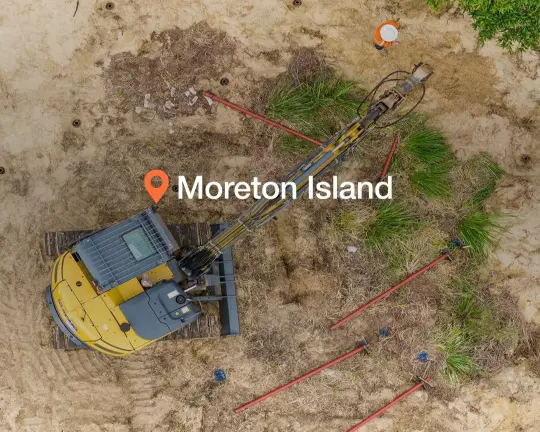
Blade Pile was engaged by builder Kayu Group to design, supply and install screw pile foundations for three elevated homes on Moreton Island.
With the island accessible only by ferry and limited road access across predominantly sandy terrain, logistics and site access presented unique challenges.
The scope included 150 Blade Piles across the three homes, installed within strip footings and integrated through an engineered pile-to-footing connection. From mobilisation through to installation and demobilisation, the entire project was completed in just five days on site.
Challenge: everything comes by ferry
Moreton Island is 37km long, roughly 95% national park, and has no road connection to the mainland. The only vehicle ferry is the Micat, which runs from the Port of Brisbane to the beach at the Tangalooma Wrecks in around 90 minutes on a demand-based timetable. Once on the island, all movement is by 4WD on sand tracks and beaches.
For a piling contractor that meant:
- Mobilisation by ferry only. All equipment, piles and machines had to be scheduled onto the Micat.
- A fixed timetable. The Micat runs to demand and can operate as little as once a day outside peak periods.
- Three builds, 150 piles. The installation team worked on a tight schedule to install 150 piles over the course of 5 days.
- Concrete was the alternative. On a ferry-access site, concrete pours that get rained out can cost the builder a lot of money and time.
Our implementation: engineered screw piles beneath strip footings
Blade Pile was responsible for the screw pile design, supply and installation, with the strip footing design and structural loads provided by the project’s engineering team.
A total of 150 Blade Piles were installed across three homes, each engineered to meet the specified design loads. The piles were installed within the strip footings, with each pile left at the required height to allow the concreter to form and pour the footings around them, incorporating the specified pile-to-footing connection.
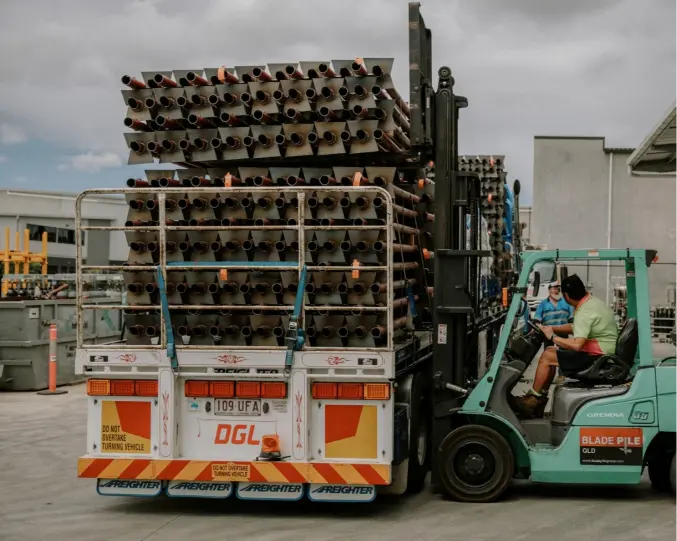
The piles specified for the project were 3.0 m Blade Piles with 76 × 4 mm shafts and 350 × 12 mm twin blades, manufactured from 450-grade steel. Each pile was engineered for a design load of 80 kN, with founding depths ranging from 3 m to 7 m. Where required, 1 m extensions were used to achieve the specified installation depths.
The piles were manufactured at Blade Pile’s Yatala factory and transported to the island alongside the installation rig and crew via the MICAT ferry from the Port of Brisbane.
Despite the logistical challenges of working on a ferry-access-only sand island, the installation was completed using a single rig and a two-man crew.
Blade Pile’s Queensland Business Development Manager and site engineer also attended the island during the installation program to inspect the works. Installation records were maintained as part of the project’s engineering documentation, with installations carried out in accordance with AS 2159.
Manufactured in-house, cut by Laser Blade
Every Blade Pile on this project was manufactured at our Yatala factory, with the twin blades profiled by our laser cutting partner Laser Blade on the TRUMPF tube laser that shares our production floor. Cutting blades and shaft profiles under the same ISO 9001 system that governs pile design and installation means the geometry the engineer specifies is the geometry that goes in the ground.
I do trust the way they’re engineered. These prices don’t change. No dry time. Straightforward.
Chris Humphries — KAYU Group
Asked why he chose screw piles over concrete for Moreton Island, Chris gave three reasons: confidence in the engineering, price certainty once the piles and rig were across, and no curing period. Asked whether he would use Blade Pile again, his answer was that it was not a question of “would” but “will”, with larger projects already planned on the same system.
Project outcome: 150 piles, three homes, five days
- 150 Blade Piles engineered, supplied and installed across three elevated homes.
- Completed in five days on site (10–14 June 2026) with no delays despite ferry-only access an average of 30 piles a day.
- One rig and a two-man crew carried the whole program, keeping the ferry mobilisation footprint to a minimum.
- Every pile installed to the engineered 80kN design load, with installation data recorded for certification.
- No concrete curing period at the installation stage; the piles are designed to be immediately load-bearing.
- Client planning further, larger projects on the same system.
A foundation system for sites the mainland rules don’t reach
Remote and elevated residential builds put pressure on the same two things: getting everything to site, and keeping the program moving once it’s there. Moreton Island brings both together, with a single vehicle ferry, a beach landing and 4WD-only access to the site.
The strip-footing-on-screw-pile design let the builder KAYU Group keep a conventional footing detail while moving the load-bearing element to an all-weather system with no curing period. Chris’s own reasons for choosing it over concrete engineering, fixed price and no dry time are the trade-offs covered in our screw piles vs concrete foundations guide, applied to a site where every lost day costs a ferry booking.
Blade Pile engineers, manufactures, supplies and installs screw pile foundation systems from our Yatala factory, with installation teams servicing Brisbane, the Gold Coast and wider South East Queensland. Contact us for a design and quote on your next project.